Cryptography
- Cryptography is the way of securing information with the use of codes so that only those persons for whom the information is meant to understand can understand it.
- It prevents unauthorized access to the sensitive data
- Word origin:
- “Crypt”: Hidden
- “Graphy”: Writing
- It relies on mathematical concepts and rules that are based on algorithms to transform messages into unreadable formats.
- Features of Cryptography:
- Confidentiality: Information can only be accessed by the intended person.
- Integrity: Information cannot be modified in the stage of storage or transition between the sender and receiver.
- Non-repudiation: The Sender cannot deny the sent information.
- Authentication: The identities of both the sender and receiver are verified, along with confirmation of the source and destination of the information.
- Interoperability: It allows for secure communication between different systems and platforms.
- Adaptability: It continuously evolves to stay ahead of security threats and technological advancements.
Types of Cryptography:
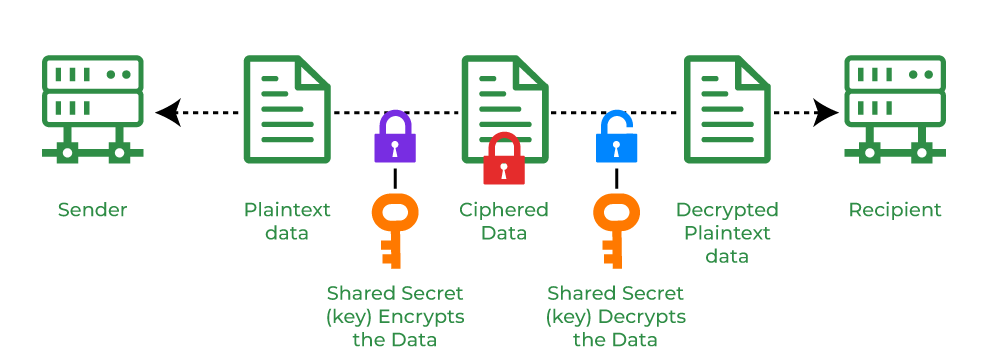
- Symmetric Key Cryptography:
- Sender and receiver of a message use a single common key to encrypt and decrypt messages.
- Fast and simple
- Sender and Receiver have to exchange key securely.
- Popular symmetric key cryptography systems: Data Encryption System(DES) and Advanced Encryption System(AES).
- Hash functions:
- No usage of any key in this algorithm.
- A hash value with a fixed length is calculated as per the plain text.
- It makes impossible for the contents of plain text to be recovered.
- Many operating systems use hash functions to encrypt password.
- Asymmetric Key Cryptography:
- A pair of keys is used to encrypt and decrypt information.
- Sender’s public key is used for encryption and a receiver’s private key is used for decryption.
- Public key and Private keys are different.
- Even if the public key is known by everyone the intended receiver can only decode it.
- The most popular asymmetric key cryptography algorithm is the RSA algorithm.
Hash functions
Applications of Cryptography
- Computer passwords:
- Used in computer security when creating and maintaining passwords.
- When the user logs in their password is hashed and compared to the hash that was previously stored.
- Password are hashed and encrypted so that even if a hacker gain access to the password database they can not read the passwords.
- Digital Currencies:
- To protect transactions and prevent frauds, digital currencies like Bitcoin also use cryptography.
- Complex algorithm and cryptographic key are used.
- It makes harder to tamper with or forge the transactions.
- Secure web browsing:
- Public key cryptography is used by the Secure Sockets Layer (SSL) and Transport Layer Security (TLS) protocols to encrypt data sent between the web server and the client.
- Electronic Signatures:
- They are created using cryptography and can be validated using public key cryptography.
- Electronic signatures are enforceable by law and their use is expanding quickly.
- Authentication:
- Used in situations like accessing a bank account, logging into a computer or using a secure network.
- They are employed by authentication protocols to confirm the user’s identity and confirm that they have the required access rights to the resources.
- Cryptocurrencies:
- Heavily used by cryptocurrencies like Bitcoin and Ethereum to protect transactions, thwart fraud, and maintain network’s integrity.
- Complex algorithms and cryptographic keys are used to protect transactions, making it harder to tamper with or forge the transactions.
- End-to-end Internet Encryption:
- Used to protect two-way communications like video conversations, messages and email.
- Widely used in communication apps like WhatsApp and Signal and it provides a high level of security and privacy for users.
Types of Cryptography Algorithm:
- Advanced Encryption Standards (AES):
- Uses the same key for encryption and decryption.
- Symmetric block cipher algorithm with block size of 128 bits, 192 bits or 256 bits.
- AES algorithm is widely regarded as the replacement of DES (Data encryption standard) algorithm.
- RSA:
- Basic asymmetric cryptographic algorithm which uses two different keys for encryption.
- RSA algorithm works on a block cipher concept that converts plain text into cipher text and vice versa.
- Secure Hash Algorithm (SHA):
- Used to generate unique fixed-length digital fingerprints of input data known as hashes.
- SHA-2 and SHA-3 are commonly used.
✔ Learning Tip
Experiment with different security tools to understand their strengths and limitations.
Experiment with different security tools to understand their strengths and limitations.